Protesting Antisemitic Violence: Jewish Responses to Cemetery Desecration in Interwar Germany
Katharina Hadassah Wendl
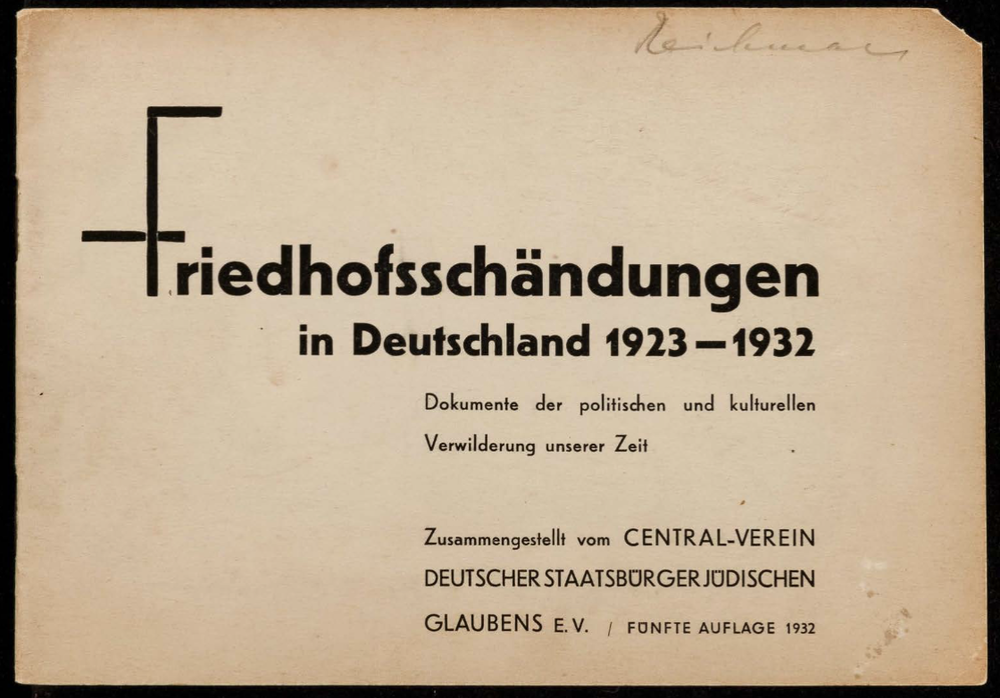
A small pamphlet held in the Leo Baeck Institute London’s collection offers striking evidence of organised, sustained Jewish resistance to antisemitism in the interwar period. Published by the Centralverein deutscher Staatsbürger jüdischen Glaubens (C.V., Central Association of German Citizens of Jewish Faith) in June 1932, the pamphlet “Friedhofsschändungen in Deutschland 1923 – 1932: Dokumente der politischen und kulturellen Verwilderung unserer Zeit”(Cemetery Desecrations in Germany, 1923–1932: Documents of the Political and Cultural Brutalisation of Our Time) documents a decade of attacks on Jewish cemeteries across Germany. More than a record of violence, though, the pamphlet testifies to organised efforts within Germany’s Jewish community to expose antisemitic crimes, mobilise public opinion, and demand accountability at a time of growing political radicalisation.
The Pamphlet and Its Purpose
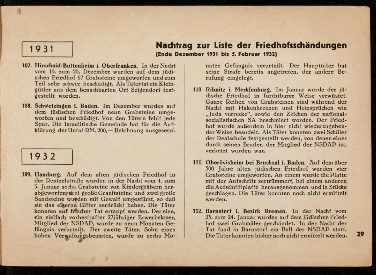
In the pamphlet, the C.V. provides a detailed account of the damage done to Jewish gravestones and cemetery infrastructure in Germany and, in doing so, serves as a call to action for Jews and non-Jews alike. It includes many photos and detailed descriptions of attacks on Jewish cemeteries and the response from police and courts. Where possible, it discusses the identity of the perpetrators and whether they could be apprehended and prosecuted. In many cases, contemporary Jewish organisations and newspapers suspected links to National Socialist milieus, although perpetrators were often never identified. In total, 112 incidents of violence against cemeteries and a further 40 against synagogues were documented in the pamphlet. Jewish newspapers reported about these crimes, too, and regularly published the C.V.’s ongoing count of instances of cemetery vandalism. For example, the newspaper Der Israelit noted in October 1931 that the damage done to the Jewish cemetery in Kirchen bei Lörrach (Baden-Württemberg) was the 106th attack against a Jewish cemeterysince the count began. “Friedhofsschändungen in Deutschland” was widely distributed and discussed in the German-Jewish press. The pamphlets in our collection are from the fifth printing, which contains supplements and updates to previous versions. At least six editions were printed before 1933.
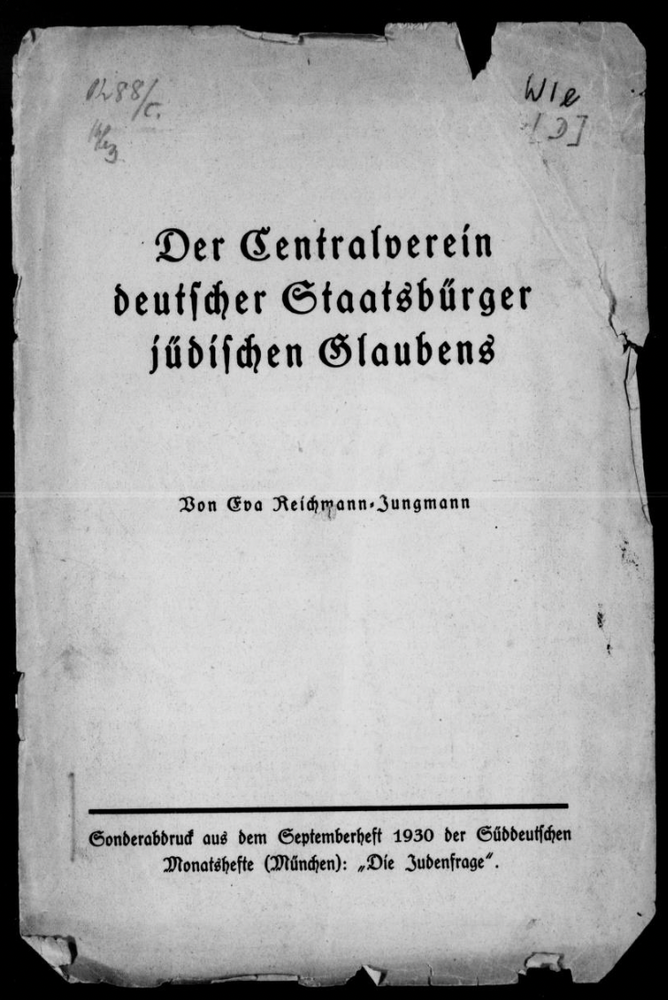
One copy of the pamphlet in the LBI London collection bears the ownership mark of the historian and sociologist Dr Eva Reichmann-Jungmann (1897–1998). Reichmann worked for the Central-Verein from 1924 to 1939 as a cultural and political advisor. She would later escape to the UK, where she became Director of Research at the Wiener Library and was closely affiliated with the LBI. Given her ownership mark and her role in the C.V., it is likely that she was directly involved in the production or dissemination of the publication.
More than Mere Vandalism
As noted by historian Julius H. Schoeps, violence against Jewish cemeteries is unique in that it does not have other denominational or non-denominational counterparts. Such attacks are particularly painful for the Jewish community not only because the dead’s rest is brutally disturbed, but also since Jewish tradition views cemeteries as eternal resting places. They serve as permanent communal fixtures and must not be moved, sold, or reused. Likewise, the graves in them may not be levelled, transferred or reused for burial or any other purpose.
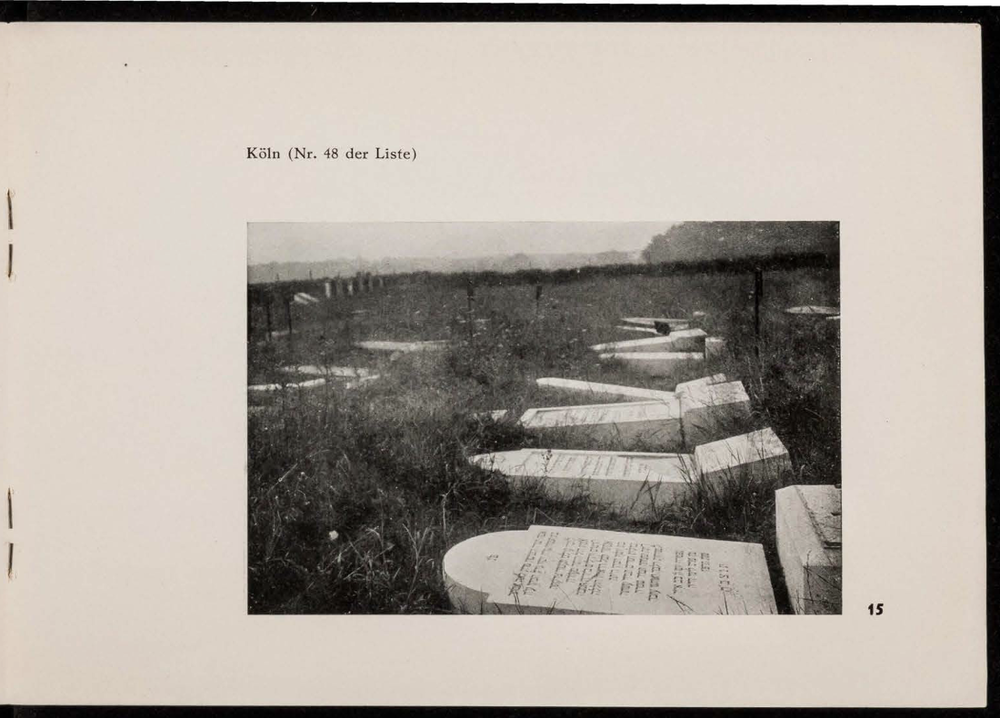
Attacks against Jewish cemeteries are not merely a modern phenomenon. Dating back to the Middle Ages, they have taken many forms, including the destruction or toppling of gravestones, damage to cemetery buildings and fences, and the smearing of graves with antisemitic slogans and symbols. As noted in the pamphlet, contemporary newspaper reporting, and in documents from the German Criminal police, it proved hard to prosecute the desecration of Jewish cemeteries, as it was often conducted under cover of the night. On the damage and response to the violence against the Jewish cemetery of Cologne in July 1929, pictured above, the pamphlet notes: “During the night of 29–30 July, 70 gravestones were knocked over. The Jewish community and the Central-Verein offered a reward of 1,500 Reichsmarks (RM). Six members of the NSDAP were suspected of the crime and were arrested; however, all of them had to be released due to lack of evidence” (page 10).
Jewish Responses to Attacks against Jewish Cemeteries
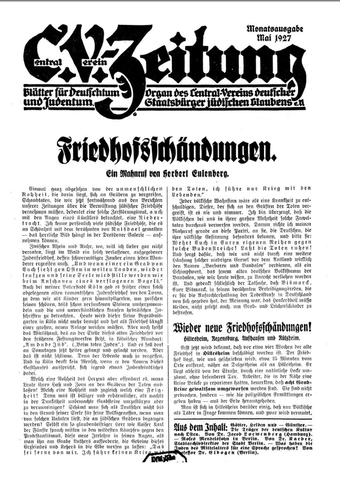
In September 1928, Die Neue Welt called the wave of antisemitic attacks against cemeteries a “ständige Erscheinung” (constant occurence), since all gravestones in the cemeteries in Flammersheim and Kirchheim had recently been damaged. The C.V. sought to intervene and help prosecution but also increase society’s awareness of the wider problem of antisemitic violence. It documented and publicised acts of vandalism against Jewish cemeteries, published pamphlets, and organised protests across German cities. At one of these protests in October 1928, the writer Julius Bab (1880-1955) called the violence “a symptom of the moral decay within the German nation,” (CV-Zeitung, 26. Oktober 1928). Other organisations, such as the Frankfurt Zionist Association, also held meetings about this pressing issue. In January 1932, three simultaneous rallies were held in Berlin. Non-Jewish people spoke out against the violence, too, such as German poet and author Herbert Eulenberg (1876–1949), a fervent opponent of Nazism, who wrote an op-ed for the C.V.-Zeitung in 1927. In it, he condemned recent attacks on Jewish cemeteries as shameful, pathetic and hateful. Prof. Dr. W. Kinkel wrote a similar text in the Jüdische Liberale Zeitung in 1929.
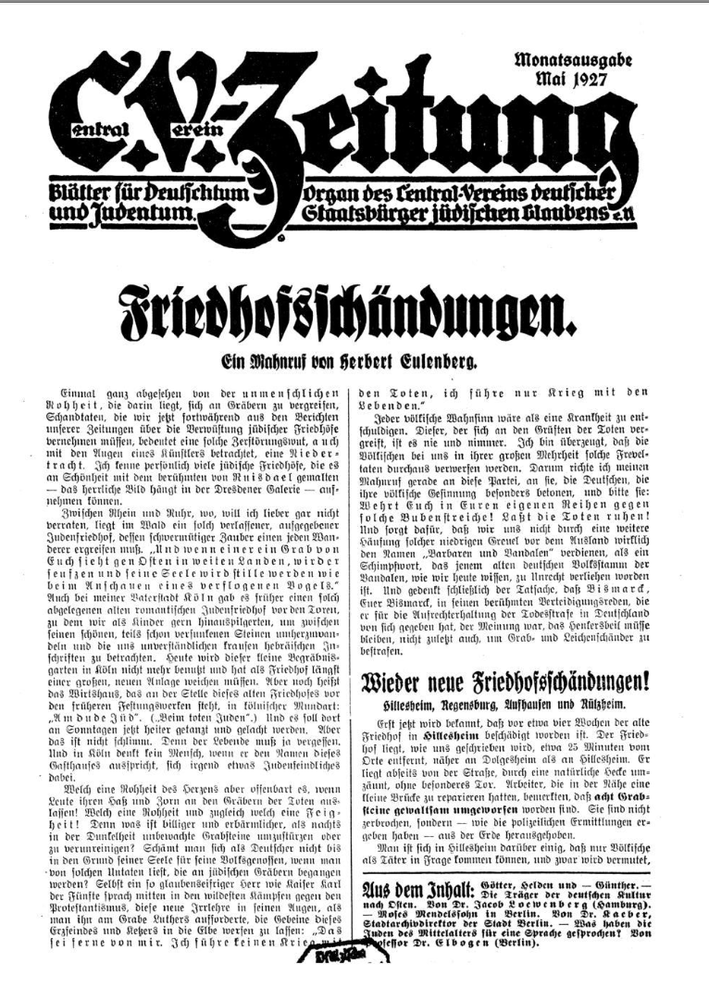
The C.V. invested considerable resources in bringing perpetrators to trial and pressing the justice and police authorities for more thorough investigation. Although it could not prevent attacks, it worked tirelessly to document antisemitic violence and keep the issue in the public eye. The pamphlet in the LBI London Collection illustrates a dimension of the C.V.’s activism that has often received less attention in the historiography. The development of the organisation’s reporting on cemetery desecrations from the Weimar era into the Nazi period offers particularly valuable insights into changing conditions for antisemitic activism and Jewish protest.
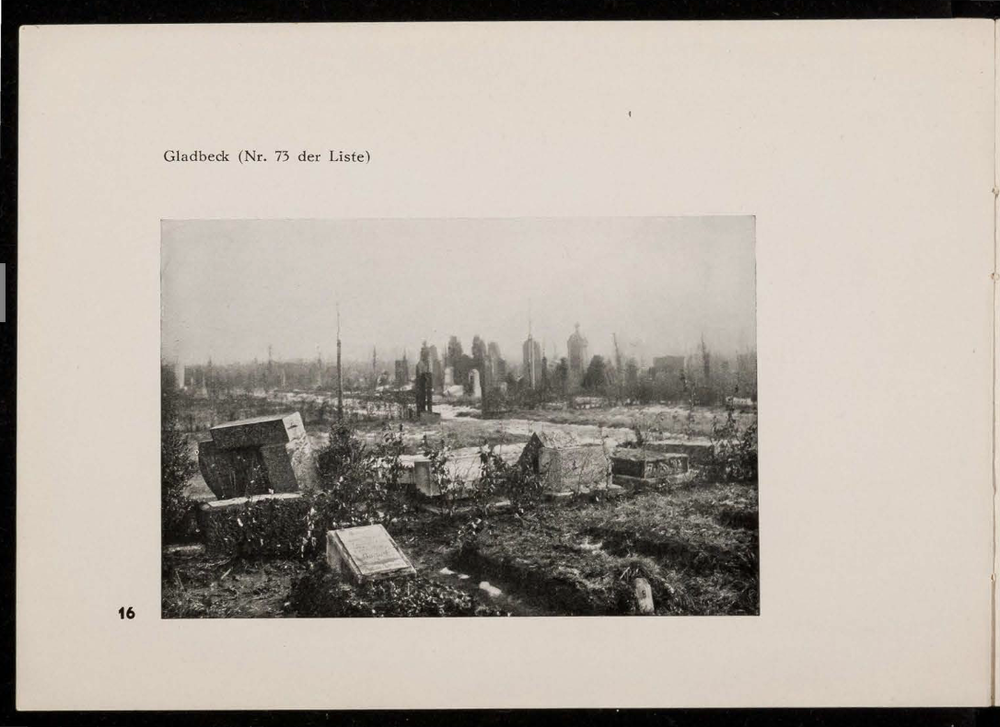
Most of the reports in the pamphlet, however, conclude that no perpetrators could be brought to justice (‘The search for the perpetrators was unsuccessful,‘The police investigation has so far produced no results’, etc.). Only rarely, as in the case of the vandalism against the Jewish cemetery in Gladbeck, pictured above, could perpetrators be identified. Shockingly, though, the two perpetrators, convicted of overturning five gravestones, vandalising several graves and cutting off flowers, had recently left the NSDAP since, as they stated, “the movement was not radical enough for them.”
Jewish Cemeteries under Threat during the Nazi Regime
During the Nazi regime, violence against Jewish cemeteries was encouraged and sanctioned. But as part of the Nazis’ attempt to control public disorder and international perceptions while still promoting antisemitism through state policy, even they condemned anti-Jewish violence against cemeteries in early 1933. Their default was to blame Marxists and other opponents of theirs.
Nevertheless, few contemporaries could have been unaware of the political milieu from which much of this violence emerged. But, as activists against antisemitism were increasingly under threat, the C.V. ceased reporting about antisemitic incidents, focusing more on cultural activities, Jewish self-aid and issues of emigration. No reliable statistics about violence against Jewish cemeteries during the Nazi period exist. But Schoeps notes that 80 to 90 percent of the about 1,700 Jewish cemeteries in Germany were desecrated, encouraged by the regime and tolerated by local authorities. The latter often sought to dissolve Jewish cemeteries and encouraged the looting of metal from Jewish cemeteries for the sake of the “Reichsmetallspende” (National Metal Donation Campaign) which sought to collect scrap metal for the war effort.
In his preface to the pamphlet, Leo Baeck (1873–1956) criticised those who would not stand up against injustice, discrimination and violence: ”“There is a history of people speaking out and calling others to action. But there is also a history of what people chose to remain silent about, and it is a history of human narrowness and moral failure,” (page 1). He then goes on to describe the C.V.’s pamphlet as a call to action for the wider German society.
The members of the C.V. stood up against antisemitism, seeking to assert German-Jewish belonging in the Weimar Republic. Judging by the number of attacks on cemeteries, their activism may have had some effect: Arnold Paucker notes that such incidents declined towards the end of the 1920s. But he bitterly adds that this was likely because the perpetrators turned to other targets and means, from attacking dead Jews to discriminating, threatening and persecuting those alive.
Further Reading:
“1932 – das Jahr der Entscheidungen: Die drei Berliner Kundgebungen des Centralvereins.” C.V.-Zeitung 11:4 (22/01/1932), 30-32.
“Aktionen gegen jüdische Geschäfte: Einschreiten des Polizeikommandanten.” Jüdische Rundschau 29 (10/03/1933), 1.
“Die deutschen Friedhofsschändungen.” Die Neue Welt, 2:53 (21/09/1928), 4.
“Die Reichsregierung gegen Synagogenbesudelung und Friedhofsschändung.” C.V.-Zeitung 7:43 (26/10/1928), 601-605, 604-605.
“Die Woche.” Der Israelit 72:41 (08/10/1931), 6.
“Frankfurter Zionistische Vereinigung: Amtliche Bekanntmachung.” Bar Kochba (December 1928), 79-80, 79.
Central-Verein deutscher Staatsbürger jüdischen Glaubens. Friedhofsschändungen in Deutschland 1923 – 1932: Dokumente der politischen und kulturellen Verwilderung unserer Zeit. Berlin: Max Lichtwitz, 1932. URL:https://digipres.cjh.org/delivery/DeliveryManagerServlet?dps_pid=IE18618930. Accessed 19 June 2026.
Denz, Rebekka; Gempp-Friedrich, Tilmann (eds.). Centralverein deutscher Staatsbürger jüdischen Glaubens: Anwalt zwischen Deutschtum und Judentum. Berlin/Boston 2021.
Epstein, Simcha. “Der Mythos der Passivität und der Kampf der deutschen Juden gegen Antisemitismus und Nationalsozialismus.” Yad Vashem Newsletter, November 2011. URL:https://www.yadvashem.org/de/education/newsletter/3/jews-against-antisemitism.html. Accessed 19 June 2026.
Eulenberg, Herbert. “Friedhofsschändungen: Ein Mahnruf,” C.V.-Zeitung, May 1927, 1-2.
Kinkel, W. “Liebe und Gerechtigkeit als Grundlage religiösen Lebens.” Jüdische Liberale Zeitung 9:16, 19/04/1929, 2-3.
Mitteilungsblatt des Landesverbandes israelitischer Religionsgemeinden Hessens, 6:10 (October 1931), 3.
Paucker, Arnold. Der jüdische Abwehrkampf gegen Antisemitismus und Nationalsozialismus in den letzten Jahren der Weimarer Republik. Hamburg: Leibniz-Verlag, 1968.
Reichmann-Jungmann, Eva. Centralverein deutscher Staatsbürger jüdischen Glaubens. Süddeutsche Monatshefte 27:12, 1930. LBI New York: Eva Reichmann Collection (AR 904 / MF 915, Box 2, Folder 4).
Schoeps, Julius H. “Ein Stein aufs Grab: Die Zerstörung und Schändung jüdischer Friedhöfe in Deutschland.” Die Zeit 46 (09/11/1984).


