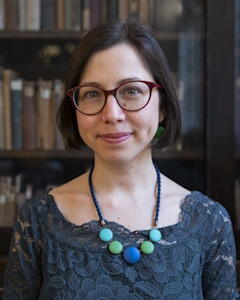
The latest feature in the Leo Baeck Institute’s Meet the Fellows series introduces Ágnes Kelemen, whose doctoral research examined the experience of Hungarian Jewish émigré students. Her first monograph Hungarian Students in Exile: Jews, Leftists, and Women, 1920–1938 is based on her doctoral thesis and is forthcoming with Indiana University Press.
Can you briefly describe your doctoral research project for a non-specialist audience? What inspired you to pursue this topic?
My doctoral research focused on the historical sociology of Hungarian Jewish émigré students during the interwar period, often referred to as “the exiles of the numerus clausus,” as they left Hungary in response to the numerus clausus law of 1920, which introduced a Jewish quota in Hungarian universities and restricted Jewish access to higher education. In my dissertation, I argued against the long-standing assumption—shared by both contemporaries and historians—that emigration was primarily an escape route for privileged Jews. On the contrary, the quota within Hungary tended to be filled by more privileged Jewish students, while those with fewer financial resources and social capital were more likely to pursue their studies abroad.
In what ways did your doctoral research prepare you for the work you are doing now?
My current research examines the foreign students of the Jewish Theological Seminary in Budapest during the period of state socialism, when it was the only non-Orthodox Jewish seminary training rabbis in the socialist bloc. I am particularly interested in the broader conditions of theological education, with special attention to rabbinical training. These themes raise questions about shtadlanut (backdoor diplomacy) and the room for maneuvre available to minorities under authoritarian regimes.
Both my doctoral research and my current work are closely connected to my studies in History, Religious Studies, and Jewish Studies. I currently serve as Assistant Professor of History at the Jewish Theological Seminary in Budapest. Between these two jobs, however, I also worked in research management, not only in academic research itself.
What have been the most rewarding and most challenging aspects of your academic journey so far?
The most rewarding aspect of my research is when descendants of numerus clausus exiles contact me to say that they came across one of my publications and that it helped them better understand some aspect of their ancestors’ life stories or see them in a new light. The most challenging aspect has been publishing my monograph, which is closely related to my dissertation yet also a substantially different work. It is forthcoming with Indiana University Press.
How has the LBI fellowship influenced your research and academic progress?
Thanks to the LBI fellowship, I had the opportunity to conduct archival research in multiple countries: Austria, Czechia, Germany, Italy, and Israel. Without these research trips, my dissertation would have been a very different project—certainly not a historical sociology grounded in data on more than one thousand émigré students.
If you could share one insight or piece of advice with future researchers interested in German-Jewish studies, what would it be?
Professional communities matter enormously. Programs such as the LBI fellowship provide invaluable opportunities to discuss work in progress with senior scholars as well as peers, and the latter is equally important. One should never miss an opportunity to receive feedback from colleagues on a text before submitting it for publication.
Is there a book, artwork, or historical figure that has particularly inspired you in your studies?
Emanuel Ringelblum who encouraged fellow Jews in the Warsaw Ghetto to document what was happening to them.


